A Sony CD player, a Ford Taurus, Mocha at Starbucks, and advice from your family doctor—all are products.
We define a product as : anything that can be offered to a market for attention, acquisition, use, or consumption and that might satisfy a want or need.
Products include more than just tangible goods to jump the distance toward intangible service.

Broadly defined, products include :
- physical objects (Goods), services, events, persons, places, organizations, ideas, experience, information, properties or mixes of these entities. Thus, throughout this text, we use the term product broadly to include any or all of these entities.
Good & Service Mix…

A company's offer to the marketplace often includes both tangible goods and services. Each component can be a minor or a major part of the total offer. At one extreme, the offer may consist of a pure tangible good, such as soap, toothpaste, or salt—no services accompany the product. At the other extreme are pure services, for which the offer consists primarily of a service. Examples include a doctor's exam or financial services. Between these two extremes, however, many goods and services combinations are possible.
For example, a company's offer may consist of a tangible good with accompanying services. Ford offers more than just automobiles. Its offer also includes repair and maintenance services, warranty fulfillment, showrooms and waiting areas, and a host of other support services. A hybrid offer consists of equal parts of goods and services.
For instance, people patronize restaurants both for their food and their service. A service with accompanying minor goods consists of a major service along with supporting goods. For example, American Airlines passengers primarily buy transportation service, but the trip also includes some tangibles, such as food, drinks, and an airline magazine. The service also requires a capital-intensive good—an airplane—for its delivery, but the primary offer is a service.
Today, as products and services become more and more commoditized, many companies are moving to a new level in creating value for their customers.
To differentiate their offers, they are developing and delivering total customer experiences. Companies that market experiences realize that customers are really buying much more than just products and services. They are buying what those offers will do for them—the experiences they gain in purchasing and consuming these products and services.

Levels of Product
Product planners need to think about products and services on five levels.

-
The most basic level is the core product, which addresses the question What is the buyer really buying? the core product stands at the center of the total product. It consists of the core, problem-solving benefits that consumers seek when they buy a product or service. A woman buying lipstick buys more than lip color.
Charles Revson of Revlon saw this early: "In the factory, we make cosmetics; in the store, we sell hope."
Ritz-Carlton Hotels knows that it offers its guests more than simply rooms for rent—it provides "memorable travel experiences."
-
Thus, when designing products, marketers must first define the core of benefits the product will provide to consumers. They must understand the total customer experience that surrounds the purchase and use of the product.
- The product planner must next build an actual product around the core product. Actual products may have as many as five characteristics: a quality level, features, design, a brand name, and packaging. For example, a Sony camcorder is an actual product. Its name, parts, styling, features, packaging, and other attributes have all been combined carefully to deliver the core benefit—a convenient, high-quality way to capture important moments.
- Then the product planner must build an expected product by which the performance of the product will meet the expectations of the buyer otherwise the buyer will be dissatisfied. for example: if you are promising the buyer with premium quality via your promotional message and the buyer finds that quality offered less than the expected level, then be sure that you lost this buyer forever, moreover you will lose at least 11 potential buyers by spreading the negative word-of-mouth.
- augmented product will be built around the core , actual and expected products by offering additional consumer services and benefits. Sony must offer more than just a camcorder. It must provide consumers with a complete solution to their picture-taking problems. Thus, when consumers buy a Sony camcorder, Sony and its dealers also might give buyers a warranty on parts and workmanship, instructions on how to use the camcorder, quick repair services when needed, and a toll-free telephone number to call if they have problems or questions.
- The last level will be the potential product which is invisible for the buyer but very clear for R&D in your organization since it’s the area which determines where & how the product will undergo in future.
Therefore, a product is more than a simple set of tangible features. Consumers tend to see products as complex bundles of benefits that satisfy their needs. When developing products, marketers first must identify the core consumer needs the product will satisfy. They must then design the actual product based on understanding the requirements of the expected product and find ways to augment it in order to create the bundle of benefits that will best satisfy consumers.
Product Classification
Products and services fall into two broad classes based on the types of consumers that use them—consumer products and industrial products.
Consumer Products
Consumer products are those bought by final consumers for personal consumption.  Marketers usually classify these goods further based on how consumers go about buying them. Consumer products include convenience products, shopping products, specialty products, and unsought products. These products differ in the ways consumers buy them and therefore in how they are marketed.
| | | |
| | Type of Consumer Product | | Marketing Considerations | Convenience | Shopping | Specialty | Unsought | | Customer buying behavior | Frequent purchase, little planning, little comparison or shopping effort, low customer involvement | Less frequent purchase, much planning and shopping effort, comparison of brands on price, quality, style | Strong brand preference and loyalty, special purchase effort, little comparison of brands, low price sensitivity | Little product awareness, knowledge (or, if aware, little or even negative interest) | | Price | Low Price | Higher price | High price | Varies | | Distribution | Widespread distribution, convenient locations | Selective distribution in fewer outlets | Exclusive distribution in only one or a few outlets per market area | Varies | | Promotion | Mass promotion by the producer | Advertising and personal selling by both producer and resellers | More carefully targeted promotion by both producer and resellers | Aggressive advertising and personal selling by producer and resellers | | Examples | Toothpaste, magazines, laundry detergent | Major appliances, televisions, furniture, clothing | Luxury goods, such as Rolex watches or fine crystal | Life insurance, Red Cross blood donations | |
- Convenience products are consumer products and services that the customer usually buys frequently, immediately, and with a minimum of comparison and buying effort. Examples include soap, candy, newspapers, and fast food. Convenience products are usually low priced, and marketers place them in many locations to make them readily available when customers need them.
- Shopping products are less frequently purchased consumer products and services that customers compare carefully on suitability, quality, price, and style. When buying shopping products and services, consumers spend much time and effort in gathering information and making comparisons. Examples include furniture, clothing, used cars, major appliances, and hotel and motel services. Shopping products marketers usually distribute their products through fewer outlets but provide deeper sales support to help customers in their comparison efforts.
- Specialty products are consumer products and services with unique characteristics or brand identification for which a significant group of buyers is willing to make a special purchase effort. Examples include specific brands and types of cars, high-priced photographic equipment, designer clothes, and the services of medical or legal specialists. A Lamborghini automobile, for example, is a specialty product because buyers are usually willing to travel great distances to buy one. Buyers normally do not compare specialty products. They invest only the time needed to reach dealers carrying the wanted products.
- Unsought products are consumer products that the consumer either does not know about or knows about but does not normally think of buying. Most major new innovations are unsought until the consumer becomes aware of them through advertising. Classic examples of known but unsought products and services are life insurance and blood donations to the Red Cross. By their very nature, unsought products require a lot of advertising, personal selling, and other marketing efforts.
Industrial Products
Industrial products are those purchased for further processing or for use in conducting a business.  Thus, the distinction between a consumer product and an industrial product is based on the purpose for which the product is bought. If a consumer buys a lawn mower for use around home, the lawn mower is a consumer product. If the same consumer buys the same lawn mower for use in a landscaping business, the lawn mower is an industrial product.
- The three groups of industrial products and services include: materials and parts, capital items, and supplies and services.

- Materials and parts include raw materials and manufactured materials and parts. Raw materials consist of farm products (wheat, cotton, livestock, fruits, vegetables) and natural products (fish, lumber, crude petroleum, iron ore). Manufactured materials and parts consist of component materials (iron, yarn, cement, wires) and component parts (small motors, tires, castings). Most manufactured materials and parts are sold directly to industrial users. Price and service are the major marketing factors; branding and advertising tend to be less important.
- Capital items are industrial products that aid in the buyer's production or operations, including installations and accessory equipment. Installations consist of major purchases such as buildings (factories, offices) and fixed equipment (generators, drill presses, large computer systems, elevators). Accessory equipment includes portable factory equipment and tools (hand tools, lift trucks) and office equipment (fax machines, desks). They have a shorter life than installations and simply aid in the production process.
- Supplies and services. Supplies include operating supplies (lubricants, coal, paper, pencils) and repair and maintenance items (paint, nails, brooms). Supplies are the convenience products of the industrial field because they are usually purchased with a minimum of effort or comparison. Business services include maintenance and repair services (window cleaning, computer repair) and business advisory services (legal, management consulting, advertising). Such services are usually supplied under contract.
| | Individual Product Decisions |
The following Figure shows the important decisions in the development and marketing of individual products and services. We will focus on decisions about product attributes, branding, packaging, labeling, and product support services.

Product Attributes
Developing a product or service involves defining the benefits that it will offer. These benefits are communicated and delivered by product attributes such as quality, features, and style and design.
Product Quality
Quality is one of the marketer's major positioning tools. Product quality has two dimensions—level and consistency. In developing a product, the marketer must first choose a quality level that will support the product's position in the target market. Here, product quality means performance quality—the ability of a product to perform its functions. For example, a Rolls-Royce provides higher performance quality than a Chevrolet: It has a smoother ride, handles better, and lasts longer. Companies rarely try to offer the highest possible performance quality level—few customers want or can afford the high levels of quality offered in products such as a Rolls-Royce automobile, a Sub Zero refrigerator, or a Rolex watch. Instead, companies choose a quality level that matches target market needs and the quality levels of competing products.
Beyond quality level, high quality also can mean high levels of quality consistency. Here, product quality means conformance quality—freedom from defects and consistency in delivering a targeted level of performance. All companies should strive for high levels of conformance quality. In this sense, a Chevrolet can have just as much quality as a Rolls-Royce. Although a Chevy doesn't perform as well as a Rolls, it can as consistently deliver the quality that customers pay for and expect.
During the past two decades, a renewed emphasis on quality has spawned a global quality movement. Most firms implemented "total quality management" (TQM) programs, efforts to improve product and process quality constantly in every phase of their operations. Recently, however, the total quality management movement has drawn criticism. Too many companies viewed TQM as a magic cure-all and created token total quality programs that applied quality principles only superficially. Today, companies are taking a "return on quality" approach, viewing quality as an investment and holding quality efforts accountable for bottom-line results.
Beyond simply reducing product defects, the ultimate goal of total quality is to improve customer satisfaction and value. For example, when Motorola first began its total quality program in the early 1980s, its goal was to drastically reduce manufacturing defects. Later, however, Motorola's quality concept evolved into one of customer-defined quality and total customer satisfaction. "Quality," noted Motorola's vice president of quality, "has to do something for the customer. . . . Our definition of a defect is 'if the customer doesn't like it, it's a defect.'" Similarly, Siemans defines quality this way: "Quality is when our customers come back and our products don't." As more and more companies have moved toward such customer-driven definitions of quality, their TQM programs are evolving into customer satisfaction and customer retention programs.
Thus, many companies today have turned customer-driven quality into a potent strategic weapon. They create customer satisfaction and value by consistently and profitably meeting customers' needs and preferences for quality. In fact, quality has now become a competitive necessity—in the twenty-first century, only companies with the best quality will thrive.
Product Features
A product can be offered with varying features. A stripped-down model, one without any extras, is the starting point. The company can create higher-level models by adding more features. Features are a competitive tool for differentiating the company's product from competitors' products. Being the first producer to introduce a needed and valued new feature is one of the most effective ways to compete.
How can a company identify new features and decide which ones to add to its product? The company should periodically survey buyers who have used the product and ask these questions: How do you like the product? Which specific features of the product do you like most? Which features could we add to improve the product? The answers provide the company with a rich list of feature ideas. The company can then assess each feature's value to customers versus its cost to the company. Features that customers value little in relation to costs should be dropped; those that customers value highly in relation to costs should be added.
Product Style and Design
Another way to add customer value is through distinctive product style and design. Some companies have reputations for outstanding style and design, such as Black & Decker in cordless appliances and tools, Steelcase in office furniture and systems, Bose in audio equipment, and Ciba Corning in medical equipment. Design can be one of the most powerful competitive weapons in a company's marketing arsenal.
Design is a larger concept than style. Style simply describes the appearance of a product. Styles can be eye catching or yawn producing. A sensational style may grab attention and produce pleasing aesthetics, but it does not necessarily make the product perform better. Unlike style, design is more than skin deep—it goes to the very heart of a product. Good design contributes to a product's usefulness as well as to its looks.
Good style and design can attract attention, improve product performance, cut production costs, and give the product a strong competitive advantage in the target market. For example, consider Apple's iMac personal computer:
Who said that computers have to be beige and boxy? Apple's iMac, is anything but. The iMac features a sleek, egg-shaped monitor and hard drive, all in one unit, in a futuristic translucent turquoise casing. There's no clunky tower or desktop hard drive to clutter up your office area. There's also no floppy drive—with more and more software being distributed via CDs or the Internet, Apple thinks the floppy is on the verge of extinction. Featuring one-button Internet access, this is a machine designed specifically for cruising the Internet (that's what the "i" in "iMac" stands for). The dramatic iMac won raves for design and lured buyers in droves. Only one month after the iMac hit the stores in the summer of 1998, it was the number-two best-selling computer. By mid-1999, it had sold more than a million units, marking Apple's reemergence as a legitimate contender in the personal computer industry.
| 
|
| The dramatic iMac—with its sleek, egg-shaped, single-unit monitor and hard drive in a futuristic translucent casing—won raves for design and lured buyers in droves. |
Branding
Perhaps the most distinctive skill of professional marketers is their ability to create, maintain, protect, and enhance brands of their products and services. A brand is a name, term, sign, symbol, or design, or a combination of these, that identifies the maker or seller of a product or service. Consumers view a brand as an important part of a product, and branding can add value to a product. For example, most consumers would perceive a bottle of White Linen perfume as a high-quality, expensive product. But the same perfume in an unmarked bottle would likely be viewed as lower in quality, even if the fragrance were identical.
Brand
Branding has become so strong that today hardly anything goes unbranded. Salt is packaged in branded containers, common nuts and bolts are packaged with a distributor's label, and automobile parts—spark plugs, tires, filters—bear brand names that differ from those of the automakers. Even fruits, vegetables, and poultry are branded—Sunkist oranges, Dole pineapples, Chiquita bananas, Fresh Express salad greens, and Perdue chickens.
Branding helps buyers in many ways. Brand names help consumers identify products that might benefit them. Brands also tell the buyer something about product quality. Buyers who always buy the same brand know that they will get the same features, benefits, and quality each time they buy. Branding also gives the seller several advantages. The brand name becomes the basis on which a whole story can be built about a product's special qualities. The seller's brand name and trademark provide legal protection for unique product features that otherwise might be copied by competitors. Branding also helps the seller to segment markets. For example, General Mills can offer Cheerios, Wheaties, Total, Lucky Charms, and many other cereal brands, not just one general product for all consumers.
Brand Equity
Brands vary in the amount of power and value they have in the marketplace. A powerful brand has high brand equity. Brands have higher brand equity to the extent that they have higher brand loyalty, name awareness, perceived quality, strong brand associations, and other assets such as patents, trademarks, and channel relationships.
A brand with strong brand equity is a very valuable asset. Measuring the actual equity of a brand name is difficult. However, according to one estimate, the brand equity of Coca-Cola is $84 billion, Microsoft is $57 billion, and IBM is $44 billion. Other brands rating among the world's most valuable include McDonald's, Disney, Sony, Kodak, Intel, Gillette, and Budweiser.
Although we normally think of brand equity as something accruing to products, service companies also prize it. As Wall Street competition intensifies, financial service companies are spending millions on their brand names in order to attract investors. Just as Coke wants you to reach for its soda when you're thirsty, Merrill Lynch and Charles Schwab want you to call them when you need financial know-how. Hence, brand-building advertising by financial services companies has soared in recent years.
High brand equity provides a company with many competitive advantages. A powerful brand enjoys a high level of consumer brand awareness and loyalty. Because consumers expect stores to carry the brand, the company has more leverage in bargaining with resellers. Because the brand name carries high credibility, the company can more easily launch line and brand extensions, as when Coca-Cola leveraged its well-known brand to introduce Diet Coke or when Procter & Gamble introduced Ivory dishwashing detergent. Above all, a powerful brand offers the company some defense against fierce price competition.
Some analysts see brands as the major enduring asset of a company, outlasting the company's specific products and facilities. Yet every powerful brand really represents a set of loyal customers. Therefore, the fundamental asset underlying brand equity is customer equity. This suggests that the proper focus of marketing planning is that of extending loyal customer lifetime value, with brand management serving as a major marketing tool.
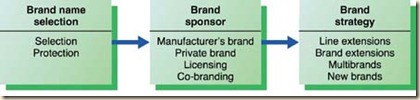
Branding poses challenging decisions to the marketer. Figure 8.3 shows the key branding decisions.
Brand Name Selection
A good name can add greatly to a product's success. However, finding the best brand name is a difficult task. It begins with a careful review of the product and its benefits, the target market, and proposed marketing strategies.
Desirable qualities for a brand name include the following:
(1) It should suggest something about the product's benefits and qualities. Examples: DieHard, Easy-Off, Craftsman, Sunkist, Spic and Span, Snuggles, Merrie Maids, and OFF! bug spray.
(2) It should be easy to pronounce, recognize, and remember. Short names help. Examples: Tide, Aim, Puffs. But longer ones are sometimes effective. Examples: "Love My Carpet" carpet cleaner, "I Can't Believe It's Not Butter" margarine, Better Business Bureau.
(3) The brand name should be distinctive. Examples: Taurus, Kodak, Exxon.
(4) The name should translate easily into foreign languages. Before spending $100 million to change its name to Exxon, Standard Oil of New Jersey tested several names in 54 languages in more than 150 foreign markets. It found that the name Enco referred to a stalled engine when pronounced in Japanese.
(5) It should be capable of registration and legal protection. A brand name cannot be registered if it infringes on existing brand names.
Once chosen, the brand name must be protected. Many firms try to build a brand name that will eventually become identified with the product category. Brand names such as Kleenex, Levi's, Jell-O, Scotch Tape, Formica, and Fiberglas have succeeded in this way. However, their very success may threaten the company's rights to the name. Many originally protected brand names, such as cellophane, aspirin, nylon, kerosene, linoleum, yo-yo, trampoline, escalator, thermos, and shredded wheat, are now generic names that any seller can use.
Brand Sponsor
A manufacturer has four sponsorship options. The product may be launched as a manufacturer's brand (or national brand), as when Kellogg and IBM sell their output under their own manufacturer's brand names. Or the manufacturer may sell to resellers who give it a private brand (also called a store brand or distributor brand). Although most manufacturers create their own brand names, others market licensed brands. Finally, two companies can join forces and co-brand a product.
Manufacturer's Brands Versus Private Brands
Manufacturers' brands have long dominated the retail scene. In recent times, however, an increasing number of retailers and wholesalers have created their own private brands (or store brands). For example, Sears has created several names—DieHard batteries, Craftsman tools, Kenmore appliances, Weatherbeater paints. Wal-Mart offers its own Sam's American Choice and Great Value brands of beverages and food products to compete against major national brands. BASF Wyandotte, the world's second-largest antifreeze maker, sells its Alugard antifreeze through intermediaries that market the product under about 80 private brands, including Kmart, True Value, Pathmark, and Rite Aid. Private brands can be hard to establish and costly to stock and promote. However, they also yield higher profit margins for the reseller, and they give resellers exclusive products that cannot be bought from competitors, resulting in greater store traffic and loyalty.
Brand Strategy
A company has four choices when it comes to brand strategy (see Figure 8.4). It can introduce line extensions (existing brand names extended to new forms, sizes, and flavors of an existing product category), brand extensions (existing brand names extended to new product categories), multibrands (new brand names introduced in the same product category), or new brands (new brand names in new product categories).

Line Extensions
Line extensions occur when a company introduces additional items in a given product category under the same brand name, such as new flavors, forms, colors, ingredients, or package sizes. Thus, Dannon introduced several line extensions, including seven new yogurt flavors, a fat-free yogurt, and a large, economy-size yogurt. The vast majority of new-product activity consists of line extensions.
A company might introduce line extensions as a low-cost, low-risk way to introduce new products in order to meet consumer desires for variety, to utilize excess capacity, or simply to command more shelf space from resellers. However, line extensions involve some risks. An overextended brand name might lose its specific meaning or heavily extended brands can cause consumer confusion or frustration. A consumer buying cereal at the local supermarket will be confronted by more than 150 brands, up to 30 different brands, flavors, and sizes of oatmeal alone. By itself, Quaker offers its original Quaker Oats, several flavors of Quaker instant oatmeal, and several dry cereals such as Oatmeal Squares, Toasted Oats, and Toasted Oats—Honey Nut. Another risk is that sales of an extension may come at the expense of other items in the line. A line extension works best when it takes sales away from competing brands, not when it "cannibalizes" the company's other items.
Brand Extensions
A brand extension involves the use of a successful brand name to launch new or modified products in a new category. Mattel has extended its incredibly popular and enduring Barbie Doll brand into new categories ranging from Barbie home furnishings, Barbie cosmetics, and Barbie electronics to Barbie books, Barbie sporting goods, and even a Barbie band—Beyond Pink. Honda uses its company name to cover different products such as its automobiles, motorcycles, snowblowers, lawn mowers, marine engines, and snowmobiles. This allows Honda to advertise that it can fit "six Hondas in a two-car garage." Swiss Army brand sunglasses, Disney Cruise Lines, Cosmopolitan low-fat dairy products, Century 21 home improvements, and Brinks home security systems—all are brand extensions.
A brand extension gives a new product instant recognition and faster acceptance. It also saves the high advertising costs usually required to build a new brand name. At the same time, a brand extension strategy involves some risk. Brand extensions such as Bic pantyhose, Heinz pet food, Life Savers gum, and Clorox laundry detergent met early deaths. The extension may confuse the image of the main brand. For example, when clothing retailer Gap saw competitors targeting its value-conscious customers with Gap-like fashions at lower prices, it began testing Gap Warehouse, which sold merchandise at a cut below Gap quality and price. However, the connection confused customers and eroded Gap image. As a result, the company renamed the stores Old Navy Clothing Company, a brand that has become enormously successful.
If a brand extension fails, it may harm consumer attitudes toward the other products carrying the same brand name. Further, a brand name may not be appropriate to a particular new product, even if it is well made and satisfying—would you consider buying Texaco milk or Alpo chili? A brand name may lose its special positioning in the consumer's mind through overuse. Companies that are tempted to transfer a brand name must research how well the brand's associations fit the new product.
Multibrands
Companies often introduce additional brands in the same category. Thus, P&G markets many different brands in each of its product categories. Multibranding offers a way to establish different features and appeal to different buying motives. It also allows a company to lock up more reseller shelf space. Or the company may want to protect its major brand by setting up flanker or fighter brands. For example, Seiko uses different brand names for its higher-priced watches (Seiko Lasalle) and lower-priced watches (Pulsar) to protect the flanks of its mainstream Seiko brand. Finally, companies may develop separate brand names for different regions or countries, perhaps to suit different cultures or languages. For example, Procter & Gamble dominates the U.S. laundry detergent market with Tide, which in all its forms captures over a 40 percent market share. Outside North America, however, P&G leads the detergent category with its Ariel brand, now Europe's number-two packaged-goods brand behind Coca-Cola. In the United States, P&G targets Ariel to Hispanic markets.
A major drawback of multibranding is that each brand might obtain only a small market share, and none may be very profitable. The company may end up spreading its resources over many brands instead of building a few brands to a highly profitable level. These companies should reduce the number of brands they sell in a given category and set up tighter screening procedures for new brands.
New Brands
A company may create a new brand name when it enters a new product category for which none of the company's current brand names are appropriate. For example, Japan's Matsushita uses separate names for its different families of products: Technics, Panasonic, National, and Quasar. Or, a company might believe that the power of its existing brand name is waning and a new brand name is needed. Finally, the company may obtain new brands in new categories through acquisitions. For example, S.C. Johnson & Son—marketer of Pledge furniture polish, Glade air freshener, Raid insect spray, Edge shaving gel, and many other well-known brands—added several new powerhouse brands through its acquisition of Drackett Company, including Windex, Drano, and Vanish toilet bowl cleaner.
As with multibranding, offering too many new brands can result in a company spreading its resources too thin. In some industries, such as consumer packaged goods, consumers and retailers have become concerned that there are already too many brands, with too few differences between them. Thus, Procter & Gamble, Frito-Lay, and other large consumer-product marketers are now pursuing megabrand strategies—weeding out weaker brands and focusing their marketing dollars only on brands that can achieve the number-one or -two market share positions in their categories.
Packaging
Packaging involves designing and producing the container or wrapper for a product. The package may include the product's primary container (the tube holding Colgate toothpaste); a secondary package that is thrown away when the product is about to be used (the cardboard box containing the tube of Colgate); and the shipping package necessary to store, identify, and ship the product (a corrugated box carrying six dozen tubes of Colgate toothpaste). Labeling, printed information appearing on or with the package, is also part of packaging.
Traditionally, the primary function of the package was to contain and protect the product. In recent times, however, numerous factors have made packaging an important marketing tool. Increased competition and clutter on retail store shelves means that packages must now perform many sales tasks—from attracting attention, to describing the product, to making the sale. Companies are realizing the power of good packaging to create instant consumer recognition of the company or brand. For example, in an average supermarket, which stocks 15,000 to 17,000 items, the typical shopper passes by some 300 items per minute, and 53 percent of all purchases are made on impulse. In this highly competitive environment, the package may be the seller's last chance to influence buyers. It becomes a "five-second commercial." The Campbell Soup Company estimates that the average shopper sees its familiar red and white can 76 times a year, creating the equivalent of $26 million worth of advertising. The package can also reinforce the product's positioning. Coca-Cola's familiar contour bottle speaks volumes about the product inside. "Even in a shadow, people know it's a Coke," observes a packaging expert. "It's a beautiful definition of how a package can influence the way a consumer perceives a product. People taste Coke differently from a contour bottle versus a generic package."
Innovative packaging can give a company an advantage over competitors. Liquid Tide quickly attained a 10 percent share of the heavy-duty detergent market, partly because of the popularity of its container's innovative drip-proof spout and cap. In contrast, poorly designed packages can cause headaches for consumers and lost sales for the company. For example, Planters Lifesavers Company recently attempted to use innovative packaging to create an association between fresh-roasted peanuts and fresh-roasted coffee. It packaged its Fresh Roast Salted Peanuts in vacuum-packed "Brik-Pacs," similar to those used for ground coffee. Unfortunately, the coffeelike packaging worked too well: Consumers mistook the peanuts for a new brand of flavored coffee and ran them through supermarket coffee-grinding machines, creating a gooey mess, disappointed customers, and lots of irate store managers.
Developing a good package for a new product requires making many decisions. First, the company must establish the packaging concept, which states what the package should be or do for the product. Should it mainly offer product protection, introduce a new dispensing method, suggest certain qualities about the product, or something else? Decisions then must be made on specific elements of the package, such as size, shape, materials, color, text, and brand mark. These elements must work together to support the product's position and marketing strategy. The package must be consistent with the product's advertising, pricing, and distribution.
In recent years, product safety has also become a major packaging concern. We have all learned to deal with hard-to-open "childproof" packages. After the rash of product tampering scares during the 1980s, most drug producers and food makers are now putting their products in tamper-resistant packages. In making packaging decisions, the company also must heed growing environmental concerns and make decisions that serve society's interests as well as immediate customer and company objectives. Shortages of paper, aluminum, and other materials suggest that marketers should try to reduce packaging. Many packages end up as broken bottles and crumpled cans littering the streets and countryside. All of this packaging creates a major problem in solid waste disposal, requiring huge amounts of labor and energy.
Fortunately, many companies have gone "green." For example, S.C. Johnson repackaged Agree Plus shampoo in a stand-up pouch using 80 percent less plastic. P&G eliminated outer cartons from its Secret and Sure deodorants, saving 3.4 million pounds of paperboard per year. Tetra Pak, a major Swedish multinational company, provides an example of the power of innovative packaging that takes environmental concerns into account.
Tetra Pak invented an "aseptic" package that enables milk, fruit juice, and other perishable liquid foods to be distributed without refrigeration or preservatives. Not only is this packaging more environmentally responsible, it also provides economic and distribution advantages. Aseptic packaging allows companies to distribute beverages over a wider area without investing in refrigerated trucks and warehouses. Supermarkets can carry Tetra Pak packaged products on ordinary shelves, allowing them to save expensive refrigerator space. Tetra's motto is "a package should save more than it cost." Tetra Pak promotes the benefits of its packaging to consumers directly and even initiates recycling programs to save the environment.
| 
|
| Environmentally responsible packaging: Tetra Pak advertises the benefits of its packaging to consumers directly and initiates recycling programs to save the environment. As this ad to producers suggests, it's "more than just a package." |
Labeling
Labels may range from simple tags attached to products to complex graphics that are part of the package. They perform several functions. At the very least, the label identifies the product or brand, such as the name Sunkist stamped on oranges. The label might also describe several things about the product—who made it, where it was made, when it was made, its contents, how it is to be used, and how to use it safely. Finally, the label might promote the product through attractive graphics.
There has been a long history of legal concerns about packaging and labels. The Federal Trade Commission Act of 1914 held that false, misleading, or deceptive labels or packages constitute unfair competition. Labels can mislead customers, fail to describe important ingredients, or fail to include needed safety warnings. As a result, several federal and state laws regulate labeling. The most prominent is the Fair Packaging and Labeling Act of 1966, which set mandatory labeling requirements, encouraged voluntary industry packaging standards, and allowed federal agencies to set packaging regulations in specific industries.
Labeling has been affected in recent times by unit pricing (stating the price per unit of standard measure), open dating (stating the expected shelf life of the product), and nutritional labeling (stating the nutritional values in the product). The Nutritional Labeling and Educational Act of 1990 requires sellers to provide detailed nutritional information on food products, and recent sweeping actions by the Food and Drug Administration regulate the use of health-related terms such as low-fat, light, and high-fiber. Sellers must ensure that their labels contain all the required information.
Product strategy calls for building a product line. A product line is a group of products that are closely related because they function in a similar manner, are sold to the same customer groups, are marketed through the same types of outlets, or fall within given price ranges. For example, Nike produces several lines of athletic shoes, Motorola produces several lines of telecommunications products, and AT&T offers several lines of long-distance telephone services. In developing product line strategies, marketers face a number of tough decisions.
The major product line decision involves product line length—the number of items in the product line. or Product line Depth by adding new versions under each brand name .
When The line is too short if the manager can increase profits by adding items; the line is too long if the manager can increase profits by dropping items. Product line length is influenced by company objectives and resources.
Product lines tend to lengthen over time. The sales force and distributors may pressure the product manager for a more complete line to satisfy their customers. Or, the manager may want to add items to the product line to create growth in sales and profits. However, as the manager adds items, several costs rise: design and engineering costs, inventory costs, manufacturing changeover costs, transportation costs, and promotional costs to introduce new items. Eventually top management calls a halt to the mushrooming product line. Unnecessary or unprofitable items will be pruned from the line in a major effort to increase overall profitability. This pattern of uncontrolled product line growth followed by heavy pruning is typical and may repeat itself many times.
The company must manage its product lines carefully. It can systematically increase the length of its product line in two ways: by stretching its line and by filling its line. Product line stretching occurs when a company lengthens its product line beyond its current range. The company can stretch its line downward, upward, or both ways.
Many companies initially locate at the upper end of the market and later stretch their lines downward. A company may stretch downward to plug a market hole that otherwise would attract a new competitor or to respond to a competitor's attack on the upper end. Or it may add low-end products because it finds faster growth taking place in the low-end segments. Mercedes-Benz stretched downward for all these reasons. Facing a slow-growth luxury car market and attacks by Japanese automakers on its high-end positioning, Mercedes-Benz successfully introduced its C-Class cars at $30,000 without harming its ability to sell other Mercedes-Benz for $100,000 or more. In a joint venture with Switzerland's Swatch watchmaker, Mercedes-Benz launched the $10,000 Smart microcompact car, an environmentally correct second car. Just 7.5 feet long, and affectionately dubbed the "Swatchmobile," the Smart is "designed for two people and a crate of beer."
Companies at the lower end of the market may want to stretch their product lines upward. Sometimes, companies stretch upward in order to add prestige to their current products. They may be attracted by a faster growth rate or higher margins at the higher end, or they may simply want to position themselves as full-line manufacturers. Thus, each of the leading Japanese auto companies introduced an upmarket automobile: Toyota launched Lexus; Nissan launched Infinity; and Honda launched Acura. They used entirely new names rather than their own names. Other companies have included their own names in moving upmarket. For example, Gallo introduced Ernest and Julio Gallo Varietals and priced these wines at more than twice the price of its regular wines. General Electric introduced GE Profile brand appliances targeted at the select few households earning more than $100,000 per year and living in houses valued at more than $400,000.
Companies in the middle range of the market may decide to stretch their lines in both directions. Marriott did this with its hotel product line. Along with regular Marriott hotels, it added the Marriott Marquis line to serve the upper end of the market, and the Springhill Suites and Fairfield Inn lines to serve the moderate and lower ends. Each branded hotel line is aimed at a different target market. Marriott Marquis aims to attract and please top executives; Marriotts, middle managers; Courtyards, salespeople and other "road warriors"; and Fairfield Inns, vacationers and business travelers on a tight travel budget. Marriott's Residence Inn provides a home away from home for people who travel for a living, who are relocating, or who are on assignment and need inexpensive temporary lodging. The major risk with this strategy is that some travelers will trade down after finding that the lower-price hotels in the Marriott chain give them pretty much everything they want. However, Marriott would rather capture its customers who move downward than lose them to competitors.
| 
|
| Product line stretching: Mercedes introduced several smaller, lower-priced models, including the $10,000 Smart microcompact car in a joint venture with Swatch. Affectionately dubbed the "Swatchmobile," the Smart is "designed for two people and a crate of beer." |
An alternative to product line stretching is product line filling—adding more items within the present range of the line. There are several reasons for product line filling: reaching for extra profits, satisfying dealers, using excess capacity, being the leading full-line company, and plugging holes to keep out competitors. Thus, Sony filled its Walkman line by adding solar-powered and waterproof Walkmans and an ultralight model that attaches to a sweatband for joggers, bicyclers, tennis players, and other exercisers. However, line filling is overdone if it results in cannibalization and customer confusion. The company should ensure that new items are noticeably different from existing ones.
An organization with several product lines has a product mix. A product mix (or product assortment) consists of all the product lines and items that a particular seller offers for sale. Avon's product mix consists of four major product lines: cosmetics, jewelry, fashions, and household items. Each product line consists of several sublines. For example, cosmetics breaks down into lipstick, eyeliner, powder, and so on. Each line and subline has many individual items. Altogether, Avon's product mix includes 1,300 items. In contrast, a typical Kmart stocks 15,000 items, 3M markets more than 60,000 products, and General Electric manufactures as many as 250,000 items.
A company's product mix has four important dimensions: width, length, depth, and consistency. Product mix width refers to the number of different product lines the company carries. For example, Procter & Gamble markets a fairly wide product mix consisting of many product lines, including paper, food, household cleaning, medicinal, cosmetics, and personal care products. Product mix length refers to the total number of items the company carries within its product lines. P&G typically carries many brands within each line. For example, it sells eight laundry detergents, six hand soaps, six shampoos, and four dishwashing detergents.
Product line depth refers to the number of versions offered of each product in the line.

Thus, P&G's Crest toothpaste comes in three sizes and two formulations (paste and gel). Finally, the consistency of the product mix refers to how closely related the various product lines are in end use, production requirements, distribution channels, or some other way. P&G's product lines are consistent insofar as they are consumer products that go through the same distribution channels. The lines are less consistent insofar as they perform different functions for buyers.
These product mix dimensions provide the handles for defining the company's product strategy. The company can increase its business in four ways. It can add new product lines, thus widening its product mix. In this way, its new lines build on the company's reputation in its other lines. The company can lengthen its existing product lines to become a more full-line company. Or it can add more versions of each product and thus deepen its product mix. Finally, the company can pursue more product line consistency—or less—depending on whether it wants to have a strong reputation in a single field or in several fields.
Services Marketing
Services are growing even faster in the world economy, making up a quarter of the value of all international trade. In fact, a variety of service industries—from banking, insurance, and communications to transportation, travel, and entertainment—now accounts for well over 60 percent of the economy in developed countries around the world.
Nature and Characteristics of a Service
A company must consider four special service characteristics when designing marketing programs: intangibility, inseparability, variability, and perishability. These characteristics are summarized in Figure 8.5 and discussed in the following sections.
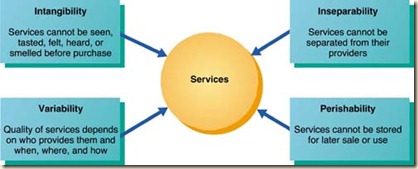
- Service intangibility means that services cannot be seen, tasted, felt, heard, or smelled before they are bought. For example, people undergoing cosmetic surgery cannot see the result before the purchase. Airline passengers have nothing but a ticket and the promise that they and their luggage will arrive safely at the intended destination, hopefully at the same time. To reduce uncertainty, buyers look for "signals" of service quality. They draw conclusions about quality from the place, people, price, equipment, and communications that they can see. Therefore, the service provider's task is to make the service tangible in one or more ways. Whereas product marketers try to add intangibles to their tangible offers, service marketers try to add tangibles to their intangible offers.
- Physical goods are produced, then stored, later sold, and still later consumed. In contrast, services are first sold, then produced and consumed at the same time. Service inseparability means that services cannot be separated from their providers, whether the providers are people or machines. If a service employee provides the service, then the employee is a part of the service. Because the customer is also present as the service is produced, provider-customer interaction is a special feature of services marketing. Both the provider and the customer affect the service outcome.
- Service variability means that the quality of services depends on who provides them as well as when, where, and how they are provided. For example, some hotels—say, Marriott—have reputations for providing better service than others. Still, within a given Marriott hotel, one registration-desk employee may be cheerful and efficient, whereas another standing just a few feet away may be unpleasant and slow. Even the quality of a single Marriott employee's service varies according to his or her energy and frame of mind at the time of each customer encounter.
- Service perishability means that services cannot be stored for later sale or use. Some doctors charge patients for missed appointments because the service value existed only at that point and disappeared when the patient did not show up. The perishability of services is not a problem when demand is steady. However, when demand fluctuates, service firms often have difficult problems. For example, because of rush-hour demand, public transportation companies have to own much more equipment than they would if demand were even throughout the day. Thus, service firms often design strategies for producing a better match between demand and supply. For instance, hotels and resorts charge lower prices in the off-season to attract more guests. Restaurants hire part-time employees to serve during peak periods.
Marketing Strategies for Service Firms
Just like manufacturing businesses, good service firms use marketing to position themselves strongly in chosen target markets. Southwest Airlines positions itself as a no-frills, short-haul airline charging very low fares. Ritz-Carlton Hotels positions itself as offering a memorable experience that "enlivens the senses, instills well-being, and fulfills even the unexpressed wishes and needs of our guests." These and other service firms establish their positions through traditional marketing mix activities.
However, because services differ from tangible products, they often require additional marketing approaches. In a product business, products are fairly standardized and can sit on shelves waiting for customers. But in a service business, the customer and frontline service employee interact to create the service. Thus, service providers must interact effectively with customers to create superior value during service encounters. Effective interaction, in turn, depends on the skills of frontline service employees and on the service production and support processes backing these employees.
The Service-Profit Chain
Successful service companies focus their attention on both their customers and their employees. They understand the service-profit chain, which links service firm profits with employee and customer satisfaction. This chain consists of five links:
- Internal service quality: superior employee selection and training, a quality work environment, and strong support for those dealing with customers, which results in . . .
- Satisfied and productive service employees: more satisfied, loyal, and hard-working employees, which results in . . .
- Greater service value: more effective and efficient customer value creation and service delivery, which results in . . .
- Satisfied and loyal customers: satisfied customers who remain loyal, repeat purchase, and refer other customers, which results in . . .
- Healthy service profits and growth: superior service firm performance.
Therefore, reaching service profits and growth goals begins with taking care of those who take care of customers.
All of this suggests that service marketing requires more than just traditional external marketing using the four Ps. Figure 8.6 shows that service marketing also requires internal marketing and interactive marketing. Internal marketing means that the service firm must effectively train and motivate its customer-contact employees and all the supporting service people to work as a team to provide customer satisfaction. For the firm to deliver consistently high service quality, marketers must get everyone in the organization to practice a customer orientation. In fact, internal marketing must precede external marketing.

Interactive marketing means that service quality depends heavily on the quality of the buyer-seller interaction during the service encounter. In product marketing, product quality often depends little on how the product is obtained. But in services marketing, service quality depends on both the service deliverer and the quality of the delivery. Service marketers cannot assume that they will satisfy the customer simply by providing good technical service. They have to master interactive marketing skills as well.
Today, as competition and costs increase, and as productivity and quality decrease, more service marketing sophistication is needed. Service companies face three major marketing tasks: They want to increase their competitive differentiation, service quality, and productivity.
Managing Service Differentiation
In these days of intense price competition, service marketers often complain about the difficulty of differentiating their services from those of competitors. To the extent that customers view the services of different providers as similar, they care less about the provider than the price.
The solution to price competition is to develop a differentiated offer, delivery, and image. The offer can include innovative features that set one company's offer apart from competitors' offers. For example, airlines have introduced innovations such as in-flight movies, advance seating, air-to-ground telephone service, and frequent flier award programs to differentiate their offers. British Airways even offers international travelers a sleeping compartment, hot showers, and cooked-to-order breakfasts.
Service companies can differentiate their service delivery by having more able and reliable customer-contact people, by developing a superior physical environment in which the service product is delivered, or by designing a superior delivery process. For example, many banks offer their customers electronic home banking as a better way to access banking services than having to drive, park, and wait in line.
Finally, service companies also can work on differentiating their images through symbols and branding. For example, the Harris Bank of Chicago adopted the lion as its symbol on its stationery, in its advertising, and even as stuffed animals offered to new depositors. The well-known Harris lion confers an image of strength on the bank. Other well-known service symbols include The Travelers' red umbrella, Merrill Lynch's bull, and Allstate's "good hands."
| 
|
| Service companies differentiate their images through symbols and branding. Note the now very familiar "Allstate: You're in good hands" brand and symbol at the bottom of this ad. |
Managing Service Quality
One of the major ways a service firm can differentiate itself is by delivering consistently higher quality than its competitors do. Like manufacturers before them, most service industries have now joined the total quality movement. Like product marketers, service providers need to identify the expectations of target customers concerning service quality. Unfortunately, service quality is harder to define and judge than is product quality. For instance, it is harder to get agreement on the quality of a haircut than on the quality of a hair dryer. Customer retention is perhaps the best measure of quality—a service firm's ability to hang onto its customers depends on how consistently it delivers value to them.
Service companies want to ensure that customers will receive consistently high-quality service in every service encounter. However, unlike product manufacturers who can adjust their machinery and inputs until everything is perfect, service quality will always vary, depending on the interactions between employees and customers. Problems will inevitably occur. As hard as they try, even the best companies will have an occasional late delivery, burned steak, or grumpy employee. However, although a company cannot always prevent service problems, it can learn to recover from them. Good service recovery can turn angry customers into loyal ones. In fact, good recovery can win more customer purchasing and loyalty than if things had gone well in the first place. Therefore, companies should take steps not only to provide good service every time but also to recover from service mistakes when they do occur.
The first step is to empower frontline service employees—to give them the authority, responsibility, and incentives they need to recognize, care about, and tend to customer needs. At Marriott, for example, well-trained employees are given the authority to do whatever it takes, on the spot, to keep guests happy. They are also expected to help management ferret out the cause of guests' problems and to inform managers of ways to improve overall hotel service and guests' comfort.
Studies of well-managed service companies show that they share a number of common virtues regarding service quality. Top service companies are customer obsessed and set high service quality standards. They do not settle merely for good service; they aim for 100 percent defect-free service. A 98 percent performance standard may sound good but, using this standard, 64,000 Federal Express packages would be lost each day, 10 words would be misspelled on each printed page, 400,000 prescriptions would be misfilled daily, and drinking water would be unsafe 8 days a year.
Top service firms also watch service performance closely, both their own and that of competitors. They use methods such as comparison shopping, customer surveys, and suggestion and complaint forms. For example, General Electric sends out 700,000 response cards each year to households that rate their service people's performance. Citibank takes regular measures of "ART"—accuracy, responsiveness, and timeliness—and sends out employees who act as customers to check on service quality.
Good service companies also communicate their concerns about service quality to employees and provide performance feedback. At Federal Express, quality measurements are everywhere. When employees walk in the door in the morning, they see the previous week's on-time percentages. Then, the company's in-house television station gives them detailed breakdowns of what happened yesterday and any potential problems for the day ahead.
==================
Source:
-Marketing, an introduction – P.Kotler
- Marketing Management – Kotler & Keller
- Strategic Marketing – Hooley


